“Observed Exposure”
Earlier this week, Anthropic published a study measuring the gap between what AI can theoretically do in the workforce and what it’s actually being used for. They call the metric “observed exposure,” and the finding is stark: the gap is enormous, and it runs through all industries.
In Computer and Math occupations—the category with the deepest technical literacy and the fewest cultural barriers to adoption—large language models could theoretically handle ninety-four percent of tasks. Actual professional usage covers thirty-three percent. In Legal, Education, Business and Finance, the pattern is the same: vast theoretical capability, modest real-world footprint. The radar chart in their report tells the whole story at a glance. Theoretical coverage fans out in a wide blue envelope across nearly every field. Observed usage huddles in a small red cluster near the center, roughly the same size regardless of the occupation. The shape of the red doesn’t track the shape of the blue. It tracks the shape of human behavior.
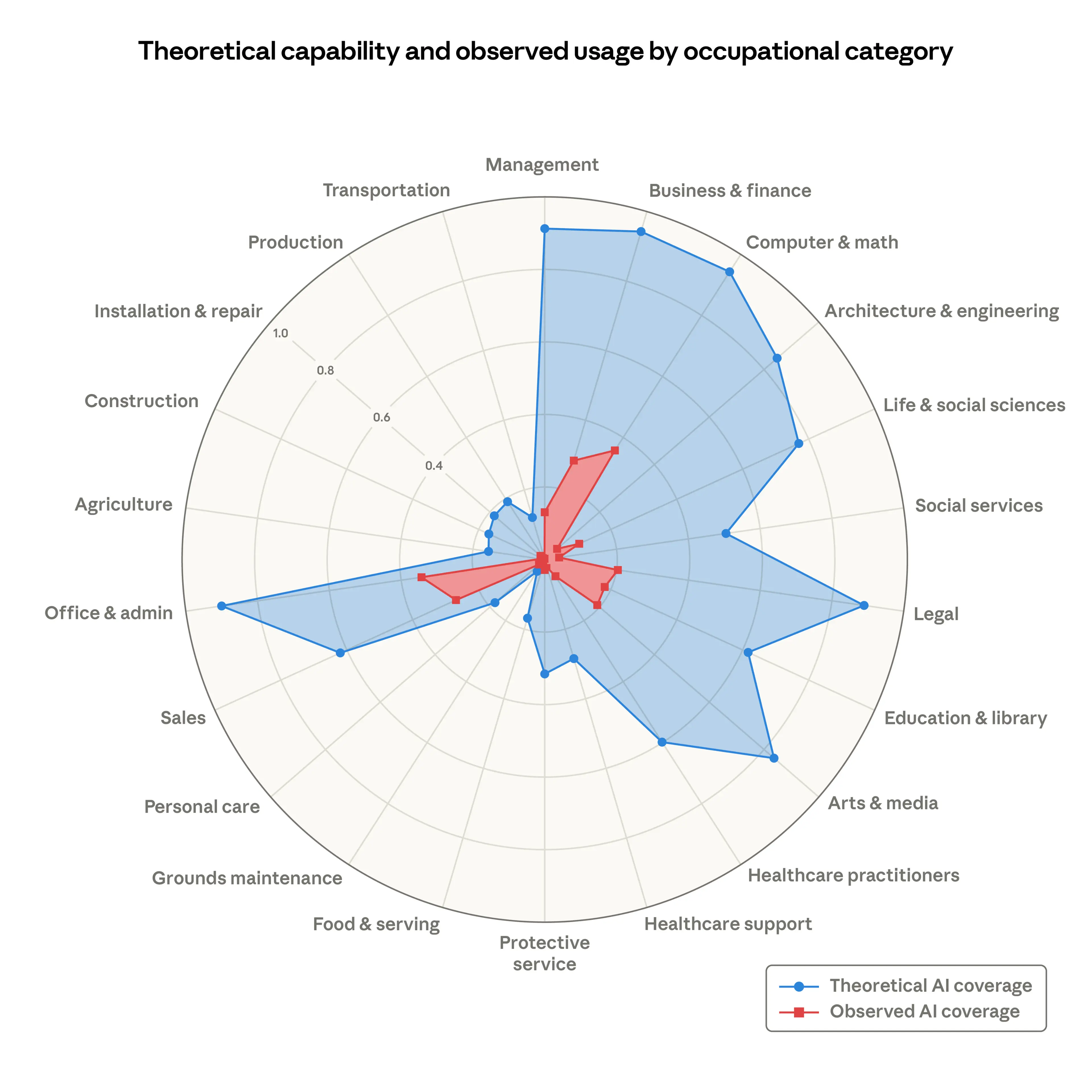
Silicon Valley looks at that chart and sees a growth problem—an adoption curve waiting to be steepened, a market waiting to be captured. I look at it and see something different. I see the brakes working.
I design AI architectures at a midsize midwestern bank. I’ve watched teams with access to frontier models and well-designed systems still struggle to move from pilot to production. The failure mode is almost never technical. It’s the review committee that meets biweekly. It’s the compliance officer who needs to understand what the model did before signing off. It’s the senior analyst who doesn’t trust the extraction because she’s been burned by bad automation before. It’s the six-week approval cycle for a workflow change that an AI can execute in seconds.
For a long time, I treated this friction as the enemy. My job, as I understood it, was to close the gap—to push observed usage closer to theoretical capability as fast as I could. Every workshop was an attempt to accelerate adoption. Every architecture decision was optimized for reducing the distance between what the model could do and what the organization would let it do.
The Anthropic study caused me to pause and think more deeply. Not because it showed the gap was bigger than I thought—I already knew it was big. Because it showed the gap was uniform. It doesn’t matter whether the field is technically sophisticated or not. It doesn’t matter whether the organization is a bank in Omaha or a software company in San Francisco. The distance between theoretical and observed capability is roughly the same everywhere. That’s not a series of local failures. That’s a pattern.
The observed usage gap exists for reasons that are illegible to the people trying to close it.
Some of the reasons are structural. Regulated industries have compliance requirements that aren’t optional and can’t be automated away by fiat. A model that can draft a loan covenant summary in seconds is useless if nobody with signing authority trusts it enough to act on the output. Trust is not a deployment problem. It’s a relationship built over time between a human and a system, and no amount of architectural elegance accelerates it past a certain floor.
Some of the reasons are institutional. Organizations have memory. They remember the last three technology transformations that were going to change everything—and the wreckage each one left behind when it was deployed faster than it was understood. The senior analyst who insists on checking every AI extraction by hand isn’t being irrational. She’s applying a heuristic that has served her well across decades of tools that overpromised and underdelivered. Her skepticism has a cost, but it also has a function: it catches the failures that the system’s designers didn’t anticipate, because she’s seen failure modes that the designers haven’t lived through.
Some of the reasons are epistemological. There’s a difference between a model being able to perform a task and an organization knowing that the model can perform a task, and a further difference between knowing it and being willing to depend on it. These are not the same state, and you can’t skip from the first to the third. It’s slow because it’s supposed to be slow. Understanding isn’t something you can push; it’s something that has to be pulled by the person doing the understanding.
Here’s the claim I want to make carefully, because it cuts against everything my industry incentivizes me to believe: the gap between theoretical capability and observed usage is not, in the short term, a problem to be solved. It’s a buffer that’s protecting organizations from moving faster than they can think.
Consider the alternative. If observed usage tracked theoretical capability—if every organization immediately deployed AI to the full extent of what the models can do—we’d be running ninety-four percent of Computer and Math tasks through systems that nobody has had time to audit, stress-test, or develop institutional understanding of. We’d be automating legal analysis, financial review, and medical documentation at a pace set by the model’s capability rather than by the organization’s capacity to verify the output. In regulated industries, that’s not innovation. It’s negligence with a venture pitch.
Silicon Valley’s cultural instinct is to treat friction as waste. Move fast and break things. The observed usage gap is friction, so it must be inefficiency, and inefficiency is what technology exists to eliminate. But some friction is structural integrity. The six-week approval cycle is maddening when you’re the engineer who built the workflow, but it exists because someone, at some point, learned the hard way what happens when you skip it. The compliance officer who wants to understand what the model did isn’t blocking progress. She’s the last line of defense between a confident system and an unexamined failure.
I’ve spent my time trying to close that gap. I’m starting to think the more important work is learning which parts of it to keep.
None of this means the gap should be permanent, or that every instance of organizational friction is justified. Some of it is genuine dysfunction—bureaucratic inertia dressed up as prudence, risk aversion that protects careers rather than outcomes. The challenge is that you can’t distinguish productive friction from wasteful friction without understanding the organization deeply enough to know why each piece exists. And that understanding is itself the slow, human, non-automatable work that the gap is made of.
So how do you close the gap responsibly?
Not by eliminating the brakes, but by making them literate. The compliance officer shouldn’t be removed from the loop. She should understand the system well enough to know when her review is essential and when it’s redundant. The review committee shouldn’t be dissolved. It should be equipped to evaluate AI-generated output on its own terms rather than applying frameworks designed for human-authored work. The senior analyst’s skepticism shouldn’t be overridden. It should be made precise—converted from a general distrust of automation into a specific understanding of where this model fails and where it doesn’t.
That’s what our internal workshops were actually doing, even when I thought they were about adoption. They were building the organizational literacy that lets the gap close safely. The irony is that I was frustrated by how slow it was going. I wanted the gap to shrink faster. I didn’t understand that the speed of the shrinking was the literacy developing.
There’s one more thing in the Anthropic data that I keep coming back to.
They found no meaningful rise in unemployment among workers in highly exposed occupations. The mass displacement everyone fears hasn’t materialized. But they did find that hiring of young workers into those occupations has slowed. Not a collapse. A thinning. The people with established careers are protected, for now. The people trying to enter are finding fewer openings.
This is where the brakes have a cost.
I’ve been at my bank for over eleven years. I learned to build things by being given the chance to build them badly first, under supervision, in an environment that tolerated my learning curve. If organizations are using AI to skip that step—routing the junior work to the model instead of to the junior hire—then the absorption gap becomes self-reinforcing. Today’s gap is a coordination problem: we have the capability but not the organizational capacity to use it. Tomorrow’s gap could be a talent problem: we’ll have the systems but not the people who understand them deeply enough to maintain, question, and extend them.
The brakes are protecting us now. But if they’re also preventing us from investing in the next generation of people who will eventually need to operate the system at full capacity, then we’re trading a short-term buffer for a long-term deficit. The observed usage gap buys time. The question—the one I haven’t answered, the one I don’t think anyone has answered—is whether we’re using that time well.
The data says we’re not using it yet. The gap is roughly the same size everywhere, which means almost nobody has figured out how to convert the breathing room into genuine organizational readiness. We’re just... pausing. Hesitating at the threshold of capability, not because we’ve decided how to proceed but because we haven’t.
I don’t think the answer is to push harder. I don’t think it’s to stop pushing either. I think it’s to recognize that the bottleneck I wasn’t solving—the human, institutional, epistemological work of building an organization that can absorb what AI makes possible—is the actual work. Not adjacent to the technical work. Not downstream of it. The work itself.