Pianississimo
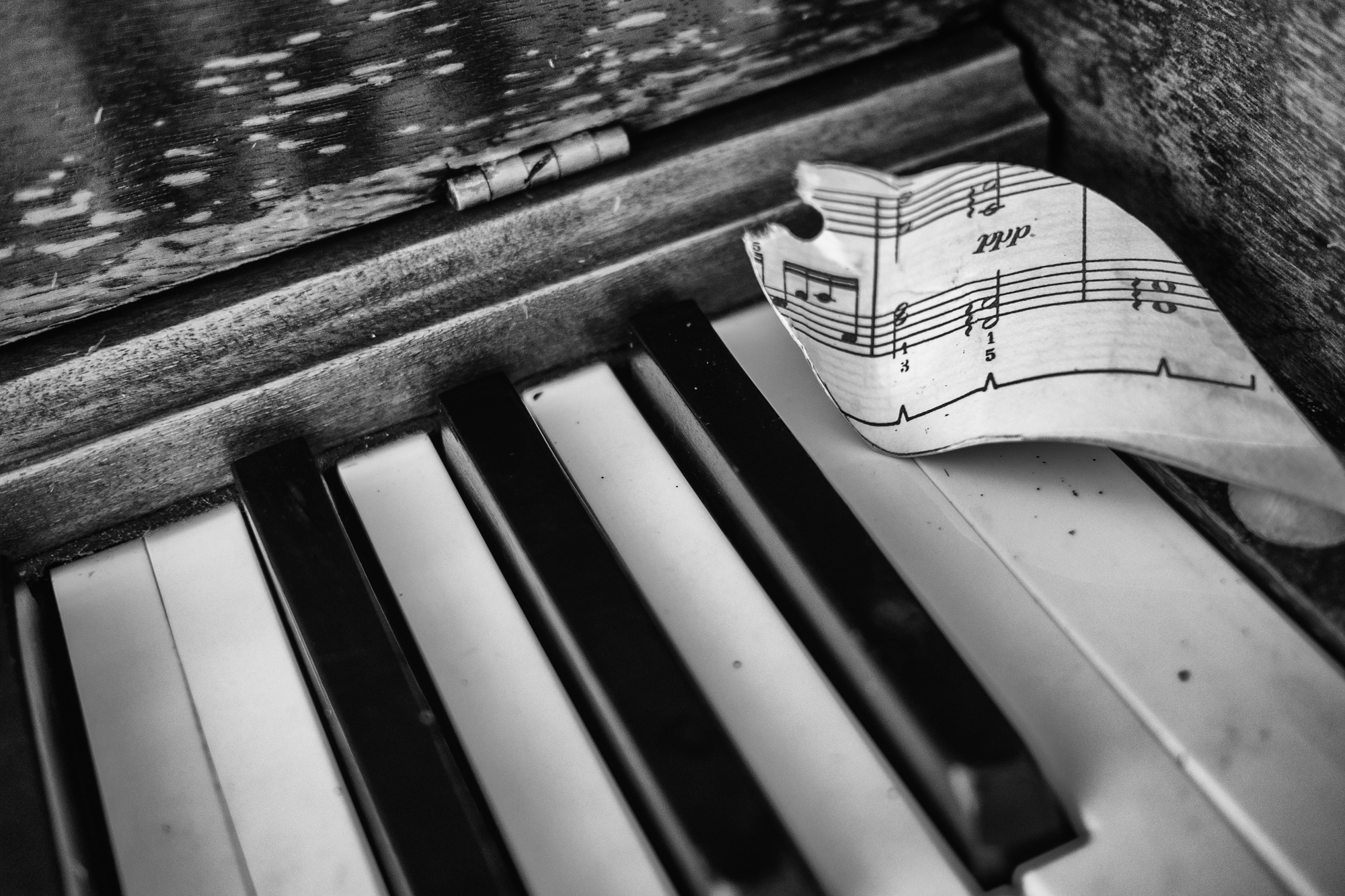
After a storm, I found a piano that had been left outside. The kind of instrument someone places in a park because they rightly believe in the transformative power of the arts. The storm didn't share that belief. It took the finish off the wood and warped what it could reach.
I sat down and attempted a Chopin Nocturne. The piano refused. Some keys stuck while others gave only silence. It was, by any reasonable measure, a broken instrument.
I almost got up. There's a particular embarrassment in trying to make music from something that can no longer produce it. The dignified thing would have been to stand, acknowledge the loss, and walk away. I kept playing.
On the keys, a scrap of sheet music had survived. Curled, rain-stained, marked ppp. Pianississimo. As quiet as possible. The storm had taken nearly everything, and what remained was a whisper. I photographed it because it was still there. It sat with a weathered defiance that appealed to me.
Somewhere, a freshly tuned Steinway sits in a concert hall, capable of producing the entire Nocturne with precision that piano will never match—every note tuned to perfection, every hammer voiced to match its neighbor. But what I photographed wasn't a performance, and the piano was no longer an instrument. Yet, it survived.
Lately, I've been thinking about that piano when I sit down to write, knowing a model could produce a competent version of this essay in seconds. I think about it when I practice, knowing a recording exists of every piece I'll ever learn, performed better than I will ever perform it.
Every domain of expertise has its protected claim. For writers, voice. For musicians, interpretation. For programmers, the elegant architectural solution committed to code. Every one of those claims rests on the same foundation: the belief that human cognition is categorically different from computation. Not just different in degree but different in kind.
This was never an empirical argument. It was a theological one. We needed it to be true, so we defended it like doctrine. Each key that goes silent, we tell ourselves the next one will hold. The obvious question we're compelled to ask at this point is: Are we special?
It feels urgent. It feels like the question. And it sends you down a path with no good ending, because you're asking a machine to adjudicate your own significance. You've defined your value as a function of scarcity, and scarcity is exactly what these systems destroy.
I know this because I've been down the path. I build AI systems for a living, which means I occupy the particular absurdity of automating the kind of work I was trained to do by hand. I've watched tasks that once took a team of engineers and a quarter's worth of effort collapse into an afternoon. I've built the tools that collapsed them. There were nights I closed my laptop and couldn't name what, exactly, I was still for. The ground I stand on is ground I'm actively reshaping. If that sounds like vertigo, it is.
So I grieved. Not loudly, not dramatically—but in the subtle way you grieve something that disappears as you're still using it. The version of myself that was special because no machine could do what I do. That grief is real, and no one should pretend it doesn't cost something. But grief is not the same as truth. And the question we should be asking isn't "are we special?" It's: does it matter?
The instinct is to grip tighter. To master the new tools faster than they master your role. To stay one version ahead. And there is practical wisdom in that—I won't pretend otherwise. Adaptability is not optional. But adaptability is a strategy, not a reason to get out of bed.
It's the same impulse that almost let me walk past a broken piano in a park—and then wouldn't. The desire to reach for something, even when reaching doesn't guarantee arrival. Especially then. We have always built, written, composed, and solved not because we were the only ones who could, but because the reaching is how we know ourselves. The carpenter doesn't stop working wood because a factory can produce furniture faster. The work changes. The tools change. The reaching doesn't.
I write knowing a model can write. I play knowing a recording exists. I build knowing the thing I build today may build itself tomorrow. None of that has made me want to stop. If anything, it has clarified what the wanting always was—not a bid for superiority, but something closer to necessity. Not because you're the best at it. Because it's yours.
The storm took nearly everything from that piano. I played it anyway, because my desire to play is inexhaustible.